
Understanding how to use possessive adjectives in Spanish is essential if you want to speak and write with clarity and confidence. These small but powerful words show ownership, relationships, and belonging in everyday conversations. When you master their placement and agreement rules, your Spanish instantly sounds more natural and precise, so continue reading to strengthen your grammar skills.
What Possessive Adjectives in Spanish Really Do
When you study how to use possessive adjectives in Spanish, you must first understand their purpose in a sentence. They show ownership or close relationships, such as family ties, friendships, or personal belongings. Instead of using an apostrophe like in English, Spanish relies on specific words that agree with the noun they describe.
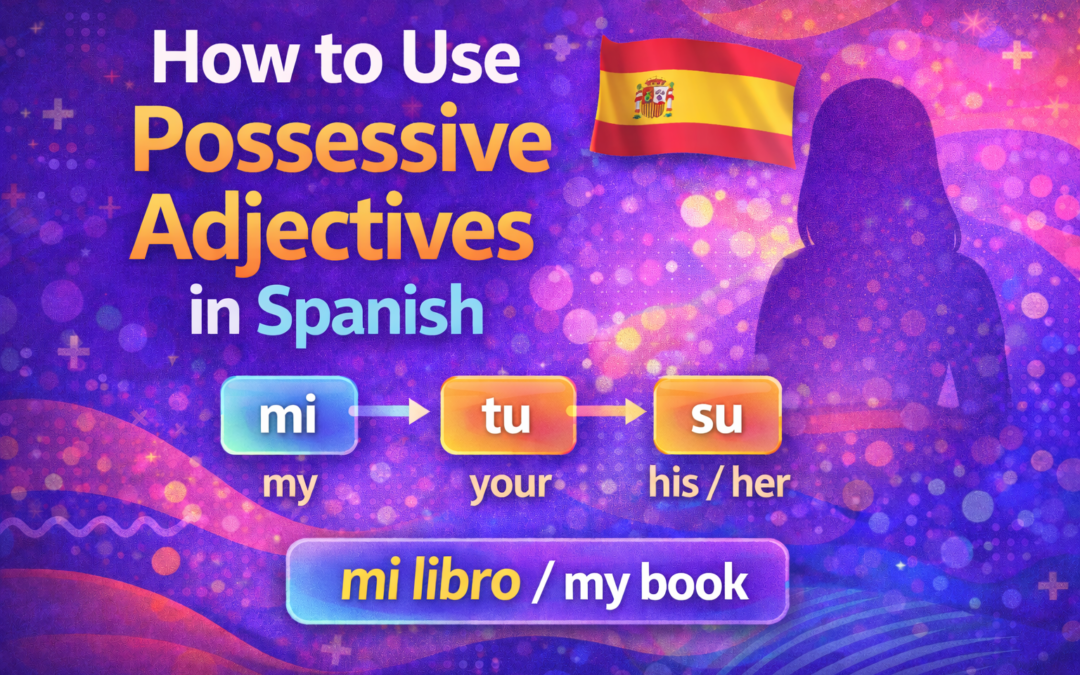
You use possessive adjectives to answer the question, “Whose is it?” clearly and efficiently. For example, mi libro means my book, and tus amigos means your friends. These words usually appear before the noun in daily speech, which makes them easy to recognize once you understand the pattern.
Possessive adjectives also express emotional connection, not just ownership. When you say mi madre or nuestro equipo, you emphasize belonging and identity. This nuance makes them a vital part of fluent Spanish communication.
The Two Types You Must Know
Spanish divides possessive adjectives into unstressed and stressed forms, and you need both to communicate effectively. The unstressed forms appear before the noun and are used most frequently in conversation. The stressed forms typically appear after the noun and add emphasis or contrast.
The unstressed forms include mi, mis, tu, tus, su, sus, nuestro, nuestra, nuestros, nuestras, vuestro, vuestra, vuestros, and vuestras. These forms change based on the number and sometimes the gender of the noun. The stressed forms include mío, mía, tuyos, suyas, and similar variations that agree in gender and number.
You will notice that mi, tu, and su do not change for gender, but they do change for number. In contrast, nuestro and vuestro change for both gender and number. Recognizing this difference allows you to apply agreement rules with accuracy.
Agreement Rules That Control Everything
When learning how to use possessive adjectives in Spanish, agreement rules should become your top priority. The possessive adjective agrees with the noun being possessed, not with the owner. This rule prevents many common learner mistakes.
For example, in mi casa, the word mi remains the same regardless of the speaker’s gender. However, in nuestras casas, the ending changes to match the plural feminine noun casas. The agreement always reflects the noun’s gender and number.
If you want to strengthen your understanding of how modifiers work in grammar, reviewing concepts like does an adjective describe a noun can sharpen your awareness of descriptive structure across languages. This broader perspective makes Spanish possessive agreement more intuitive. Clear agreement ensures your sentences sound accurate and professional.
Placement: Before or After the Noun
Most possessive adjectives appear before the noun in Spanish. This placement creates natural, everyday expressions such as mi coche or tus ideas. It also replaces the article, which means you do not say la mi casa in standard usage.
However, stressed forms often appear after the noun to add emphasis. For example, un amigo mío highlights that the friend belongs specifically to you. This construction clarifies ownership in situations where context might be unclear.
You should use long forms carefully to avoid sounding overly formal. When applied correctly, they strengthen meaning without disrupting flow. Strategic placement improves both clarity and tone.
Avoiding Confusion with Su and Sus
The words su and sus can represent his, her, their, your formal, or your plural. This multiple meaning structure can create confusion if context is not clear. Therefore, careful sentence construction is important.
When ambiguity arises, you can replace su with a de phrase. For example, instead of su libro, you may say el libro de María to remove doubt. This approach increases precision in both spoken and written communication.
Clarity should always guide your decision-making. If a sentence feels unclear, rewrite it for accuracy. Effective communication depends on eliminating confusion.
Formal and Informal “Your” in Spanish
Spanish distinguishes between informal and formal address, which directly affects possessive adjectives. When speaking informally to one person, you use tu and tus. When addressing someone formally, you use su and sus.
In Spain, vosotros and vuestro appear in informal plural settings. In most Latin American contexts, ustedes replaces vosotros, and the possessive remains su or sus. Recognizing this variation helps you communicate appropriately across regions.
Because American learners often interact with Latin American Spanish, su is frequently more relevant than vuestro. Understanding regional usage strengthens your conversational flexibility. Adaptability improves overall fluency.
Common Mistakes You Must Avoid
One common mistake is matching the possessive adjective to the owner instead of the noun. This leads to incorrect forms that disrupt grammatical agreement. Always focus on the noun first before choosing the possessive.
Another frequent error involves punctuation and modifier structure in English, which can influence Spanish writing habits, so reviewing concepts like when to hyphenate adjectives can sharpen your grammatical awareness across languages. Precision in modifier structure builds stronger overall language skills. Attention to these details supports cleaner sentence construction.
Learners also mistakenly add articles before short-form possessives. In standard Spanish, you do not combine an article with mi, tu, or su. The possessive itself functions as the determiner.
Possessive Adjectives vs. Possessive Pronouns
Possessive adjectives accompany a noun, while possessive pronouns replace the noun entirely. For example, mi libro uses a possessive adjective, but el libro es mío uses a possessive pronoun. Understanding this distinction prevents structural confusion.
Possessive pronouns must agree in gender and number with the noun they replace. Forms such as mío, mía, míos, and mías adjust accordingly. This agreement rule mirrors possessive adjective logic.
When you master both forms, your Spanish becomes more flexible and precise. You can avoid repetition and express ideas more naturally. Structural awareness enhances fluency.
Practical Examples for Real Conversations
Applying possessive adjectives in everyday scenarios builds confidence quickly. Consider these examples:
- Mi hermano trabaja en Nueva York.
- Nuestras ideas son innovadoras.
- Tus decisiones afectan tu futuro.
Each sentence demonstrates agreement between the possessive adjective and the noun. When you practice consistently, patterns become automatic. Repetition transforms grammar into instinct.
If you want structured support while strengthening descriptive language skills, using the Adjective to Describe tool for descriptive language learning can reinforce your understanding of how adjectives function broadly. A strong grasp of adjective mechanics enhances accuracy in Spanish. Integrated practice improves long-term retention.
When to Use De Instead of a Possessive
Sometimes replacing a possessive adjective with de plus a name improves clarity. For example, el coche de Juan clearly identifies the owner. This structure eliminates ambiguity that su might create.
This technique becomes especially useful in conversations involving multiple people. Instead of relying on context alone, you specify ownership directly. Precision strengthens credibility.
In formal writing, clarity outweighs brevity. Choosing de over a possessive adjective can prevent misunderstandings. Strategic wording improves communication quality.
Building Fluency Through Consistent Practice
Mastering how to use possessive adjectives in Spanish requires regular practice. You should write sentences daily, create dialogues, and read authentic Spanish texts. Active engagement reinforces agreement rules.
Educational research shows that consistent grammar review improves retention significantly. Learners who practice multiple times per week retain substantially more information than those who study occasionally. Consistency converts rules into natural habits.
Integrate possessive adjectives into journaling, conversation practice, and reading exercises. Combining written and spoken practice strengthens comprehension and production simultaneously. Discipline produces confident communication.
Conclusion
When you fully understand how to use possessive adjectives in Spanish, you gain control over a foundational grammar structure. These adjectives allow you to express ownership, belonging, and relationships with clarity and confidence. By mastering agreement rules, placement patterns, and ambiguity solutions, you elevate both your spoken and written Spanish.
Remember that possessive adjectives agree with the noun, not the owner, and that short forms typically appear before the noun. When confusion arises, using de constructions preserves clarity and professionalism. With steady practice and attention to grammatical detail, you will apply possessive adjectives accurately and naturally in real-world communication.