
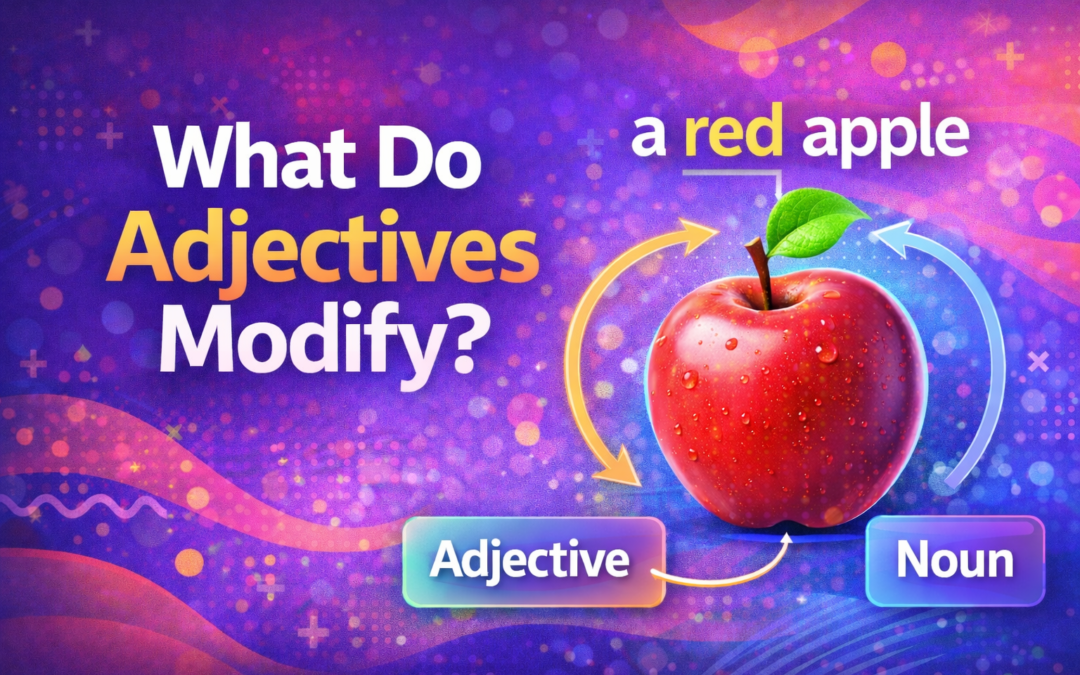
When you ask what do adjectives modify, you are asking one of the most important questions in English grammar. Adjectives give life, precision, and clarity to your sentences by adding specific details to the words they describe. If you understand exactly what adjectives modify and how they function, you strengthen your writing, improve your grammar, and communicate with confidence.
This guide explains in plain language what adjectives modify, how they work in different sentence structures, and how to avoid common errors. You will learn how adjectives interact with nouns, pronouns, linking verbs, and even other modifiers. By the end, you will apply adjectives correctly in everyday writing, academic essays, and professional communication.
What Do Adjectives Modify in a Sentence?
When you ask what do adjectives modify, the direct answer is simple: adjectives modify nouns and pronouns. They add information that tells you what kind, which one, or how many about the word they describe. Without adjectives, your sentences would feel vague and incomplete.
Consider the difference between “car” and “red car.” The adjective “red” modifies the noun “car” by adding a specific detail that helps you visualize it. In everyday American English, writers rely heavily on adjectives to create clarity, and research from the National Assessment of Educational Progress shows that precise word choice improves comprehension scores among middle and high school students.
Three Core Questions Adjectives Answer
Adjectives answer three essential questions that guide your grammar decisions. These questions help you identify whether a word is truly functioning as an adjective in context. If the word answers one of these, it likely modifies a noun or pronoun.
- What kind?
- Which one?
- How many or how much?
If a word answers one of these questions about a noun, you are seeing an adjective at work. This simple test prevents confusion and improves decision-making when editing your own writing.
Adjectives Modify Nouns Directly
In most sentences, adjectives appear directly before the noun they modify. This placement makes the relationship between the adjective and noun clear and immediate. For example, in “large house,” the adjective “large” modifies the noun “house.”
You use this pattern constantly in American writing, from academic essays to business emails. When you choose strong, specific adjectives, you create high-quality, persuasive communication that holds attention. If you want deeper clarity on whether an adjective truly describes a noun, reading about does an adjective describe a noun strengthens your understanding of that direct relationship.
Adjectives can appear in a series as well, such as “bright blue summer sky.” In that phrase, each adjective modifies the noun “sky,” and together they create a layered image. Understanding this structure helps you avoid misplaced modifiers and awkward phrasing.
Adjectives Also Modify Pronouns
Although nouns are the most common targets, adjectives also modify pronouns. In a sentence like “something strange happened,” the adjective “strange” modifies the indefinite pronoun “something.” The structure remains the same because the adjective still answers what kind.
You might see this pattern in sentences such as “everyone ready” or “nothing unusual occurred.” In each case, the adjective provides clarity about the pronoun. This flexibility allows you to write with efficiency while maintaining precision.
Pronoun modification is especially common in conversational American English. Mastering this structure helps you maintain grammatical accuracy in both formal and informal settings.
Predicate Adjectives After Linking Verbs
Adjectives do not always appear before the noun. Sometimes they follow a linking verb and still modify the subject, functioning as predicate adjectives. In “The sky is blue,” the adjective “blue” modifies “sky,” even though it appears after the verb “is.”
Linking verbs such as is, seem, look, feel, appear, and become connect the subject to an adjective. If the verb describes a state rather than an action, the word after it is often an adjective, not an adverb. Many grammar errors happen when writers confuse these two forms.
When you write “She looks tired,” you correctly use an adjective because “looks” functions as a linking verb. If you wrote “She looks tiredly,” you would change the meaning and introduce confusion.
Can Adjectives Modify Other Adjectives?
You might wonder whether adjectives can modify other adjectives. Technically, adjectives do not modify adjectives; adverbs do that job. In a phrase like “extremely fast car,” the word “extremely” modifies “fast,” and it functions as an adverb.
Understanding this distinction prevents structural errors. If you write “excessive fast growth,” you create a grammatical problem because “excessive” wants to modify a noun, not another adjective. To strengthen your grasp of this relationship, reviewing can an adverb describe an adjective clarifies how modifiers work together in layered descriptions.
When you edit your writing, check whether the modifying word answers “to what extent.” If it does, it is likely an adverb modifying an adjective rather than an adjective modifying another adjective.
Descriptive vs Limiting Adjectives
Not all adjectives function the same way. Some describe qualities, while others limit or specify. Descriptive adjectives answer what kind, while limiting adjectives answer which one or how many.
Articles such as a, an, and the function as limiting adjectives because they define the noun’s scope. Words like three, several, and many also limit nouns by quantity. Understanding this distinction improves sentence clarity and ensures accurate determiner usage.
For example, “three large houses” contains both limiting and descriptive adjectives. The number limits the noun, while “large” describes it.
Numbers and Colors as Adjectives
Numbers frequently function as adjectives when they modify nouns. In “two books,” the word “two” answers how many and modifies the noun “books.” This structure appears in academic writing, business reports, and everyday communication.
Similarly, colors act as descriptive adjectives in phrases such as “green jacket” or “dark brown table.” If you want to examine how numbers function grammatically, the explanation in are numbers adjectives shows how quantity words operate within sentence structure.
These examples show that adjectives extend beyond traditional descriptive words. They include categories that you might overlook if you only focus on vivid descriptive language.
Multiple Adjectives and Proper Order
When you use more than one adjective, English follows a conventional order. Native speakers instinctively say “small red car” rather than “red small car.” This predictable pattern enhances readability and flow.
If you are unsure whether two adjectives need a comma, the rule depends on whether they are coordinate adjectives. A practical way to decide is by testing whether you can switch their order without changing meaning. Guidance on punctuation appears in do you need a comma between two adjectives, which helps you apply this rule correctly in real writing.
Using the correct order and punctuation strengthens professional documents. It also ensures your writing aligns with American grammar standards.
Hyphenated Adjectives Before Nouns
Compound adjectives often appear before nouns and require hyphenation. For example, “high-quality product” uses a hyphen because the words work together as a single modifier. This pattern improves clarity and prevents misreading.
When the compound appears after the noun, you usually remove the hyphen, as in “The product is high quality.” Understanding when to hyphenate protects your credibility in academic and business writing. If you need deeper clarity, the tool called Adjective to Describe for descriptive language learning provides structured examples that reinforce these patterns in practical contexts.
Hyphenation rules matter because punctuation changes meaning. A misplaced or missing hyphen can alter how readers interpret your sentence.
Common Mistakes to Avoid
Writers often confuse adjectives and adverbs, especially after linking verbs. If the verb links the subject to a description, use an adjective rather than an adverb. This rule prevents errors such as “She feels badly” when you mean “She feels bad.”
Another mistake involves stacking too many adjectives without clarity. Overloading a sentence with descriptive words weakens impact and reduces readability. According to readability studies published by educational assessment groups, concise adjective use improves comprehension and retention.
Finally, avoid using adjectives without clear nouns. Make sure each adjective directly connects to the word it modifies to prevent ambiguity.
How Adjectives Improve Your Writing
When you understand what do adjectives modify, you gain control over tone and precision. You can transform a bland sentence into a vivid one by choosing accurate modifiers. Instead of writing “The presentation was good,” you can write “The presentation was insightful and data-driven.”
Precise adjectives support persuasive writing and professional credibility. In business communication, clarity influences trust and decision-making outcomes. Strong adjective use helps you communicate authority without exaggeration.
The key is balance. Use adjectives intentionally, not excessively, so each one contributes meaning rather than clutter.
Conclusion
Now you can confidently answer the question what do adjectives modify. Adjectives modify nouns and pronouns by answering what kind, which one, or how many, and they may appear before the noun or after a linking verb. They do not modify other adjectives directly, but adverbs can modify adjectives to express degree.
When you apply these principles, your writing becomes clearer, stronger, and more professional. You avoid common grammar mistakes, use punctuation correctly, and structure your sentences with precision. By mastering how adjectives function, you elevate every piece of writing you produce, from academic essays to high-performance business communication.